Nationally, only about two-thirds of young children are considered healthy and ready to learn. Kindergarten Readiness Assessments, or KRAs, help schools and communities understand the skills children bring with them as they enter kindergarten. They typically look beyond academics to areas such as language, early literacy and math, social-emotional development, and physical development.
These assessments matter because kindergarten readiness is not simply a kindergarten issue. It is the result of everything that happened during the five years before a child walked through the school doors.
I often compare kindergarten readiness to pool safety. Years ago, when my husband and I put a pool in our backyard, our children and nieces and nephews were young. Keeping them safe around that pool was incredibly important to us. But we didn’t rely on one thing to keep them safe.
We had layers.
First, there was a fence. Pool fencing is so important that communities have building codes, permits, inspections, and other requirements designed to make sure appropriate safeguards are in place. Think of that fence as policy.
We need strong policies surrounding children, too. Policymakers need to understand child development, critical periods of development, brain development, and the long-term importance of the earliest years.
We already have some fences: childcare regulations, adult-to-child ratios, quality-rating systems, school-entry requirements, and publicly funded early childhood programs. But a fence isn’t enough.
Around a pool, we may also have alarms on doors, gates and even sensors that alert adults when someone gets too close to the water. Think of these as our systems and programs.
For children, those layers include Early Intervention, Head Start, Pre-K Counts, voluntary preschool, home-visiting programs, libraries, recreation programs, pediatric healthcare, childcare, schools, and community organizations. Each adds another layer of protection and opportunity.
But alarms only work if they are turned on. Gates only work if they latch.
Our early childhood systems have gaps, too. Programs run out of funding. Families exceed income limits but still cannot afford services. Waitlists grow. Families don’t know resources exist. And children can get lost when they transition from one system to another.
Education Is Another Layer
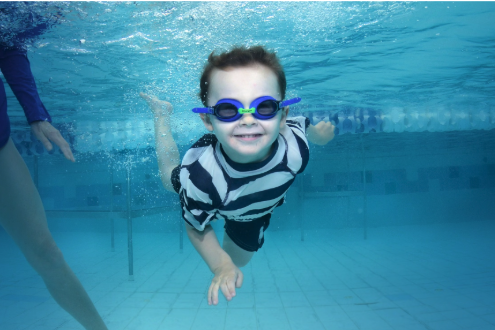
We teach children to swim long before we expect them to be strong swimmers.
My daughter started swim lessons as a tiny baby. Some days, she mostly slept on my shoulder in the pool. But we were already beginning the process of making water familiar and teaching our family about water safety. Parents need the same kind of education about child development.
Parents are often the first people who can notice that a developmental milestone hasn’t emerged. But they can only recognize a missing milestone if someone has taught them what typical development looks like and where to turn when they have concerns.
When a child is near the pool, we don’t rely solely on fences, alarms, or adult supervision. We also provide support directly to the child, such as a properly fitted, Coast Guard-approved life jacket when appropriate. This is another layer of protection, one that stays with the child.
Kindergarten readiness requires that same child-centered approach. Policies, programs, and community resources are essential, but ultimately, we must build the developmental skills within each child. Through play, movement, exploration, relationships, and everyday experiences, children develop the motor, language, cognitive, and social-emotional skills that prepare them for learning.
And just as children need different levels of support in the water, they need different levels of developmental support. Some children need more opportunities to practice, some need individualized interventions, and others need additional resources to overcome barriers. Our goal should not be to expect every child to arrive at kindergarten with identical skills, but to ensure every child has the support and opportunities needed to thrive.
Then We Need Everyday Practices
When children were swimming in our pool, we had a rule based on a simple truth: When everyone is watching, no one is watching.
We designated one adult as the official pool watcher. That person held a wooden spoon with a ribbon tied around it. If you had the spoon, your only job was watching the children. If you needed to walk away, you handed the spoon to another adult.
We also removed every toy from the pool when swimming was over so there was nothing tempting a child to reach for later. These were small, intentional practices that reduced risk.
So what are our everyday practices for kindergarten readiness?
Do families read and talk to babies from the beginning? Do babies have opportunities for tummy time, movement, exploration, and play? Do families have access to libraries, museums, parks, playgrounds, and community activities?
Do schools begin engaging children and families before the first day of kindergarten through storytimes, readiness events, school visits, and opportunities to become comfortable with the school environment?
Does the community create safe places where young children can play, move, explore, interact, and learn? Kindergarten readiness is built through thousands of these small experiences.
And We Need a Rescue Plan
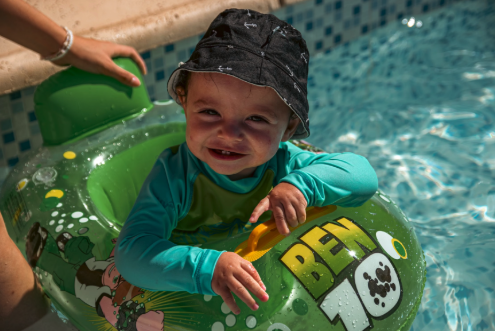
Finally, despite every pool-safety precaution, we prepare for an emergency. My husband and I maintain CPR certification because if something goes wrong, intervention needs to happen immediately. The same should be true when a child begins falling behind.
A “wait and see” approach can cost a child valuable developmental time. Once a child enters school significantly behind, identifying needs, completing evaluations, developing plans, arranging services, and providing appropriate supports can be complicated and time-consuming. Early intervention is our developmental CPR.
We should respond to developmental concerns with urgency rather than waiting for a gap to become a crisis.
Child development is a continuum.
Children don’t experience healthcare, early intervention, childcare, preschool, community programs, and public education as separate systems.
A child’s brain doesn’t know when one agency’s responsibility ends and another one begins. Development doesn’t pause while paperwork is transferred, a referral is processed, a funding stream changes, or a family sits on a waitlist.
That is why kindergarten readiness cannot belong to any one organization.
We need the fences, the alarms, education, strong everyday practices and rapid intervention when something goes wrong.
But most importantly, we need warm handoffs between every layer of the system so that families aren’t expected to navigate the gaps alone.
Instead of asking only, “What programs do we have?” we need to ask: “What does the journey look like from the child’s point of view?”
Because to children, there aren’t ten different systems. There is just childhood. And kindergarten readiness is the result of everything that happens along the way.